Sheldon Fun Days: A Grand Parade!

Sunday, July 11, 1976, 2:00

(Spirit Photos by Brent N. Bahler)

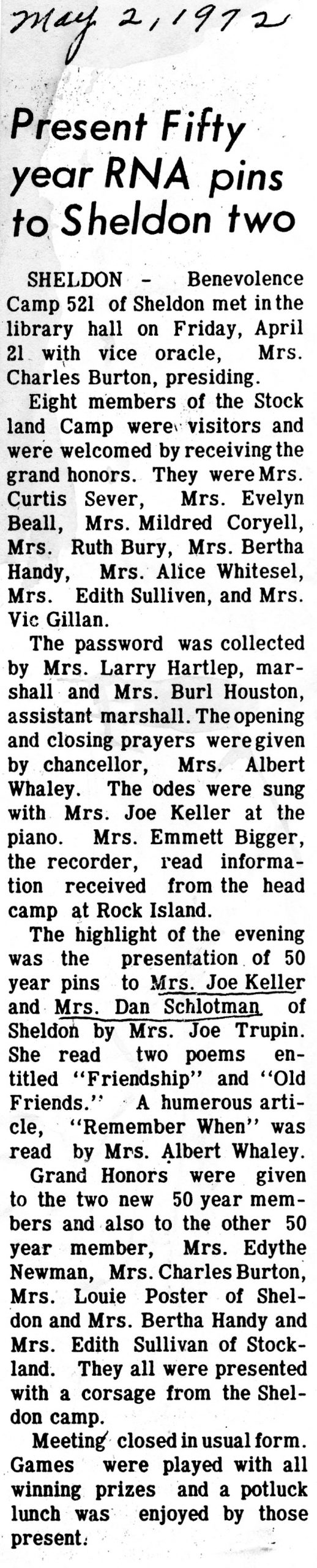
Senior King & Queen: Mr. and Mrs. Dan Schlotman

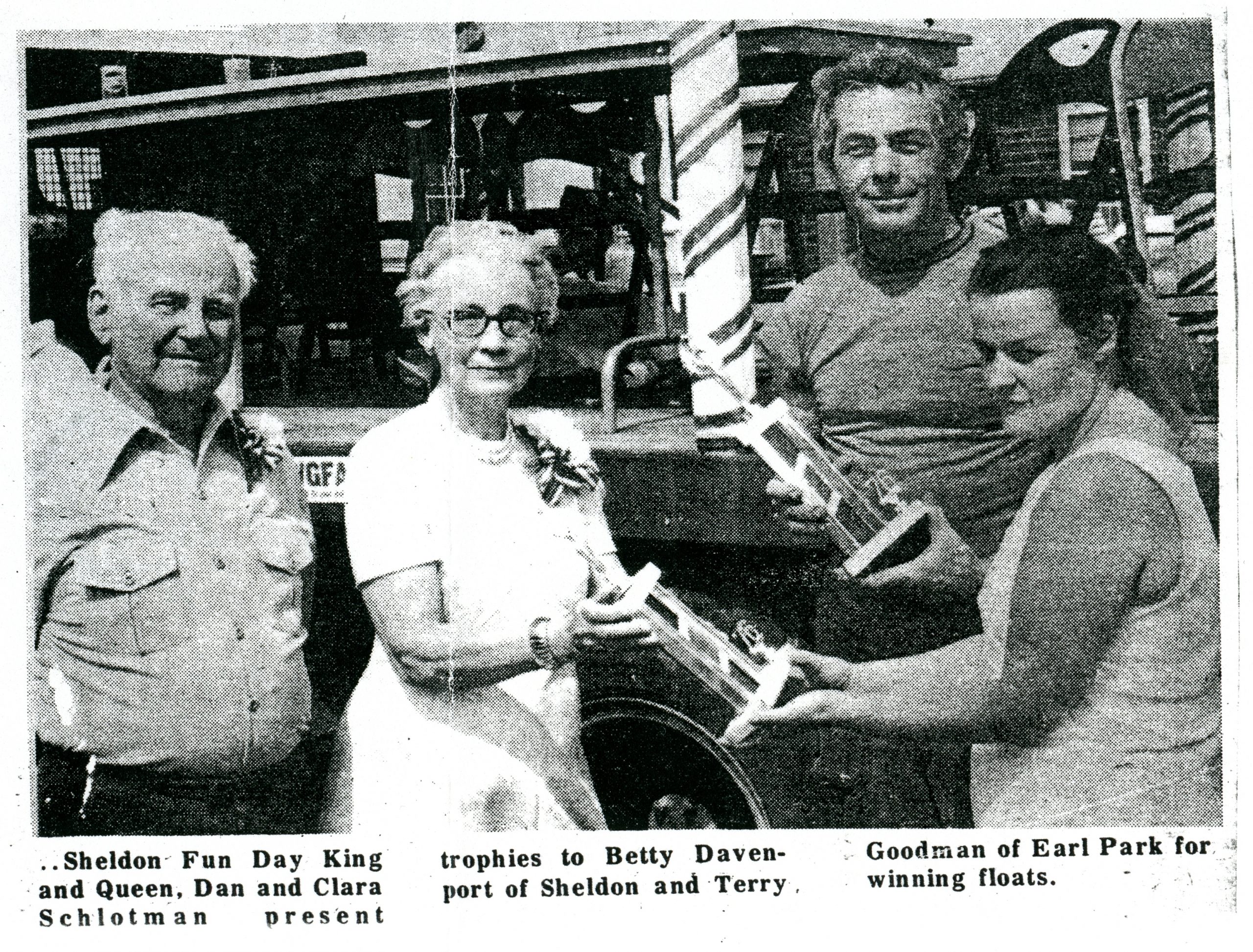
Sheldon Fun Day King and Queen, Dan and Clara Schlotman present trophies to Betty Davenport of Sheldon and Terry Goodman of Early Park for winning floats.

Source

Watseka Spirit, unknown date, but after 11 Jul 1976

Seniors Hear Travelogue

(Sheldon) – Mr. and Mrs. Dan Schlotman presented a color slide travelogue of the 2200 mile conducted bus tour of England and Scotland they had taken in August when the Sheldon Senior Citizens met on October 16. There were forty-three persons in attendance at the pot-luck dinner hostessed by Rose LeSage and Doris Long. Mrs. Long gave the invocation before the meal.

Nurses from the Iroquois County Public Health Service gave free flue shots to eighteen members. Some members also had a blood pressure check. President Clara Ingalls conducted the business session. Secretary Laverna Marshall read the account of the September meeting and Harry Brubaker gave the financial report. Lillie Arseneau, Florence Bonnett and Martha Sabo observed October birthdays. Sixteen Sheldon Seniors had attended the September meeting of the Martinton Good Neighbors Club.

John Kuntz, Iroquois County Clerk and Recorder, will be present at the November meeting to give instructions on the use of the voting machines which will be used in coming elections.

Recipe blanks were distributed for members to submit favorite recipes to be used in compiling a cookbook to be sold to the benefit of the Volunteer Services projects.

A donation of $20 was voted from the treasury to the Iroquois County Transportation Service which provides multiple trips and telecare transportation. The Sheldon Senior Citizens will ride on the mini-van to Bloomington on Wednesday, October 31 to visit the Beich Candy Factory. Gk

Source

Watseka Spirit, 24 Oct 1979

ATTEND NEW YORK WEDDING

Mr. and Mrs. Kenneth Stephens, and Mr. and Mrs. Dan Schlotman left on Sunday on a vacation trip to New York City. While there they will attend the marriage of the former’s brother, Ben Stephens, who was a speaker at the local high school basketball banquet a couple of winters ago.

Source

Unknown newspaper, but probably the Sheldon Journal. Ben Stephens was married 14 Aug 1940.

Clara Schlotman – Obituary

Clara Schlotman

WATSEKA — Clara M. Schlotman, 95, of Watseka, died Wednesday (Jan. 24, 2001) at Magnolia Wood Nursing Home, Watseka.

Visitation will be from 4-7 p.m. Saturday at the Segur-Knapp Funeral Home, Watseka.

Services will be held at 1:30 p.m. Sunday at the United Methodist Church in Sheldon. Revs. Joe Scheets, Karen Martin and Hubert Lytle will officiate.

Burial will be in Sheldon Cemetery.

Memorials may be made to the Iroquois Memorial Hospice; United Methodist Church, Sheldon; or to the donor’s choice.

She was born March 30, 1905, in Sheldon, the daughter of Nathaniel and Margaret McCarty Light.

Her husband, Daniel F. Schlotman, whom she married Aug. 20, 1927, in Watseka, died Nov. 6, 1981.

Surviving are two daughters and one son-in-law, Phyllis Kingdon of Watseka, Marcia and Francis Sowers of Kentland, In.; six grandchildren, eight great-grandchildren and two great-great-grandchildren.

Five brothers and four sisters are deceased.

She was a member of the First United Methodist Church, Watseka.

Source

This was on a laminated bookmark given by the funeral home and had the twenty-third Psalm on the back. It is probably the same one that was published in the Watseka Times Republic.

ANNUAL GARDEN PARTY A SUCCESS

Last Thursday evening was perfect for the annual Garden Party held at the Dan Schlotman home and sponsored by the ladies of the Sheldon Methodist Church.  One hundred and seventy-five guests gathered for an enjoyable program of music which had been arranged for their pleasure and entertainment.

The air was warm, the moon high, together with soft lights, throughout the garden, made a very inviting place to spend an evening.  Small tables each decorated with miniature bouquets were scattered around the lawn, at which the guests were seated as they arrived.  Large baskets of flowers were placed around the garden. The following musical program was given:

Vocal solo: Clara Ingalls.
Piano solo, Patricia McCarty.
Vocal solo, Mrs. Naomi Darrough
Piano solo, Phyllis Schlotman.
Vocal solo, Helen Bussert.
Piano selection, Mrs. Ima Silvers.
Several numbers by the Tonett Players, Marcia Jones, Marcia Schlotman, Joanne Courtright, Jo Ellen Kusch, Mary Jo and Sharon Trummel.
Tuba solo, Irvin Hollingsworth.
Trio, Mrs. Mabel Nichols, Miss Helen Bussert, Irvin Hollingsworth.

At the close of the program refreshments of sandwiches, cookies, and coffee were served.

Source

Unknown newspaper, but probably Sheldon Journal, Aug 1943

Clara Light and Dan Schlotman are Married

LIGHT—SCHLOTMAN NUPTUALS SATURDAY

Miss Clara Marie Light and Dan Schlotman of Sheldon were the principals in a quiet wedding solemnized at the Methodist parsonage in Watseka at 4 30 o’clock Saturday evening, August 20, 1927, by the Rev. Stanley Ward pastor of the M. E. church of that place.

The bride is the youngest daughter of Mrs. Margaret Light of this place. She is a graduate of the S. C. H. S. class of ’25 and last year was a most successful teacher near Gilman.

The groom is a graduate of the Sheldon High School and attended the U. of I. He is the son of Oscar Schlotman residing south of town and for the past several years has assisted his father on the farm.

The many Sheldon friends of Mr. and Mrs. Schlotman join in wishing them much happiness in their wedded life and extend congratulations and best wishes.

Source

Unknown paper, but probably Sheldon Journal, marriage date was 20 Aug 1927


SCHLOTMAN-LIGHT

Miss Clara Light and Dan Schlotman, both of this place, were quietly married at the M. E. parsonage in Watseka at five o’clock Saturday evening by the Rev. Stanley Ward, pastor of the church.

Sheldon friends extend congratulations and best wishes to the happy couple.

Source

Unknown Newspaper, probably Sheldon Journal, marriage date was 20 Aug 1927

Clara Schlotman — Fifty Years a Royal Neighbor

Honored at a meeting of the Sheldon, Ill., camp, were Neighbors Genevieve Keller and Clara Schlotman, pictured at right, left and right, respectively, when they were presented their coveted gold 50-year membership jewels. A detailed account of the meeting may be found in the Illinois camp news section of this issue of the Royal Neighbor.

Source

Unknown publication, unknown date, the even took place on 21 Apr 1972.


Present Fifty year RNA pins to Sheldon two

SHELDON — Benevolence Camp 521 of Sheldon met in the library hall on Friday, April 21 with vice oracle, Mrs. Charles Burton, presiding.

Eight members of the Stockland Camp were visitors and were welcomed by receiving the grand honors. They were Mrs. Curtis Sever, Mrs. Evelyn Beall, Mrs. Mildred Coryell, Mrs. Ruth Bury, Mrs. Bertha Handy, Mrs. Alice Whitesel, Mrs. Edith Sullivan, and Mrs. Vic Gillan.

The password was collected by Mrs. Larry Hartlep, marshal and Mrs. Burl Houston, assistant marshal. The opening and closing prayers were given by chancellor, Mrs. Albert Whaley. The odes were sung with Mrs. Joe Keller at the piano. Mrs. Emmett Bigger, the recorder, read information received from the head camp at Rock Island.

The highlight of the evening was the presentation of 50 year pins to Mrs. Joe Keller and Mrs. Dan Schlotman of Sheldon by Mrs. Joe Turpin. She read two poems entitled “Friendship” and “Old Friends.” A humorous article, “Remember When” was read by Mrs. Albert Whaley.

Grand Honors were given to the two new 50 year members and also to the other 50 year members, Mrs. Edythe Newman, Mrs. Charles Burton, Mrs. Louie Poster of Sheldon and Mrs. Bertha Handy and Mrs. Edith Sullivan of Stockland. They all were presented with a corsage form the Sheldon camp.

Meeting close in usual form. Games were played with all winning prizes and a potluck lunch was enjoyed by those present.

Source

Unknown newspaper, 2 May 1972

Recollections of Clara Light Schlotman

Summer of 1999

In 1999, while visiting my great-grandmother, Clara Schlotman, I gave her a tape recorder and tapes and asked if she would record some stories for me.  I transcribed the tape, and this is the result.

Well, here I am again.  I’m going to try to tell you something that I don’t know too much about.  On the farm we had a building called the crib, which stored the corn on either side of the building and in the center, you could drive a wagon or use it for a storage space or whatever.  Well, when the proper time came (now I can’t remember what time of the year it would be–it was nice weather, I know) the geese that we raised on the farm (we had ducks and geese and chickens) would be driven into the center of this building and closed up.  My mother always took a chair, she put on a big apron, and she would pick up one of these geese, one at a time, lay it on its back across her lap, and pluck feathers from its breast.  Now, she didn’t bare that breast, she just, I don’t know how she knew, but anyway, the breast was left covered. And she’d save those feathers and put them in a bag.  That was down. That’s what you made your down pillows from.  And she’d take each one and as she finished with one, it was put outside and each one was plucked until they were all done.  But I don’t know how long it took to have enough down for a pillow, I have no idea, but that’s the way that they were plucked. Then…I don’t know where to go from here.  I guess we’ll stop right here for a little bit.

Well, here I go again.  I was going to tell about when you live on the farm.  There’s always so much work to be done.  The men have a lot of work.  They work from early morning until late at night and after the chores were done at night, the cows were milked (and I guess that they might have milked them at night too, I don’t remember) and supper over, the family all gathered in the living room and talked and laughed and told stories and played games.  You never once thought of saying “I’m going to town” or “I’ll be back, so and so.” Everybody was home and went to bed and had a good night’s rest, because tomorrow brings another day.  They had to work hard, as well as the women because they had all those beds to make and change and they had to cook and fix a good meal.  Breakfast consisted of meat, potatoes and gravy and whatever.  Of course, I was never up early.  But when I got up, there was a place for me waiting. I loved to take a slice of bread and pull it into little parts, and just and stack it on my plate way up high, and then put gravy on top of that.  Oh, that was so good!  But that’s been a long time ago.  Now, as I was telling you, we were on the farm.  I had a big yard to play in, but I didn’t go out of the yard unless somebody was with me, because there was always animals — cows and pigs and horses and whatever we had was around.  And then there would be, some distance from the house, a plot of ground where we’d have watermelons out there.  We had plenty of watermelons and musk melons.  And then we had the garden which had plenty of potatoes that we would dig.  Aunt Nona was the one that was always around to dig potatoes and gather things from the garden.  So, if we wanted watermelon, sometimes we’d just walk out into the patch and we’d thump the watermelons to see how they sounded.  If they sounded like they were good and ripe, we’d just pick it up and drop it and it would break into several pieces.  And we’d stand right there and eat that watermelon. Oh my, we’d spit out all those seeds, oh! *chuckle*, it was great.  Oh!  So, that’s it for now.

Here I am again with another tale.  When I was just quite small, everybody told me that Santa Claus lived in Iceland.  So, one day I thought, “well I’ll just talk to him myself and find out.”  So, I remember there was a telephone hanging on the wall, a big, old-fashioned thing and you had to ring to get central and get through.  So, I rang the ringer (on the side was a thing to ring it) and central said, (oh I don’t remember I suppose she said) “Central.”  And I said, “Well, give me Santa Claus at Iceland.”  I don’t know where my mother was, but about that time she got me down off that chair and I never did get to talk to Santa. That’s it! *chuckle*

Well, hello. Here we go again.  I was going to tell you about…besides farming, my father owned and operated a threshing machine.  Now, that consisted of a steam engine, water tank, (the whatever it was, where they put the oats in, and it took the hulls and everything off of the oats and the corn…that was called) the sheller.  He did his own business at home and then he would go out into the neighborhood and help the neighbors with all of this. Of course, I’m assuming that they paid him for this.  I don’t (of course I wasn’t big enough to) know.  But anyway, he was a busy man. And he was a gentle, soft-spoken man, and had a beard, and he was a great guy.  That’s all for right now.

Good morning! Today is my father’s birthday, so I thought I’d talk a little bit about him.  His health began to fail and he couldn’t any longer farm.  But he thought that he’d be able to do something.  So he bought a restaurant in Sheldon and he had a sale and sold his farm equipment and we moved to Sheldon.  It was a nice, big restaurant and there was a living space up above.  I was seven years old and I started to school in Sheldon, the first grade at age seven.  Anyway, my mother did the cooking and my father was downstairs, of course.  Then, there were a couple of the boys that helped occasionally. But oh, I was so proud of that.  The windows were deep seated and we had little white curtains to the back of them and the display in the windows was big jars of candy.  I don’t remember what else but I do remember the candy in lovely big, big jars.  There was a little girl that lived in the apartment not too far down the street from where we were.  So, I walked to school with her.  I learned the city by walking to school with her.  She was real nice.  Her name was Mirla Dibble.  She wasn’t well.  She was a very frail little girl and she didn’t live maybe ten years later. We weren’t in the restaurant to long until my father saw that he wasn’t going to be able to do that.  So, we found a home in Sheldon and he closed the restaurant.  We lived not to far from town and everything was working out well as far as I was concerned.  (I fell down the basement once.  We had a trap door in the kitchen, and I went rushing through, and the door was open, and down I went.  Maybe that’s what hurt my head today *chuckle*!  Well, I just thought I’d tell you about that.) Then we moved a couple of more times until we found the right home for us.  My father wasn’t able to do anything.  He had such headaches.  And the doctor had told him to soak his feet in real hot water and that would take the blood from the brain and would relieve him.  Anyway, this went on for some time.  And so finally, he passed away and then we were left without him.  That’s all now.

Good morning.  This is June the second, 1999.  It is now about 10:00 in the morning, temperature around sixty-eight degrees.  The Sky is partly cloudy.  And it’s to be about 70 degrees today, a little cooler than what we’ve been having.  I had my air conditioner put in yesterday.  It was pretty warm on Saturday, but now that I have it in, it’s cool.  Well, I think that I haven’t been too busy, but that’s all right.  We went Memorial Day to Marcia’s in the evening.  Day before, we had gone to the cemetery to do some decorating and that’s been about it.  You know this may just be my last recording.  I can’t think of anything, really.  I had a very simple life, I had fun.  But I can’t remember everything, and it wouldn’t be fun to you if it repeated, so this is the way it goes.  I went to school every day and I came home and worked–maybe did ironing or something necessary, studied, maybe go to the library in the evening.  But on the whole, everything was very simple.  Since I can’t think of anything more at this moment, I’ll wish you all adieu and maybe I’ll see you all again.
Clara Light, Country School Teacher

In this sepia-toned head-and-shoulders portrait, Clara wears round glasses, bobbed and finger-waved hair with bangs, and a dress or blouse with a lace collar and a bow at the neckline.  She looks into the camera and, though she looks pleasant, she isn't smiling.
Clara Light
Sheldon High School
Class of 1925

My great-grandmother, Clara Marie Light Schlotman (1905-2001) had a short career as a country schoolteacher in the mid-1920s. After talking to her daughter (my grandmother) in 2021, I did a little research and was able to put together this information.

After graduating from Sheldon (Illinois) High School in 1925, Clara Light attended Mrs. Brown’s Normal Training School for Teachers in Homer, Illinois. She was one of about forty students that summer. The students gathered at Mrs. Brown’s home for a group photo, shown below

Mrs. Lucy Brown is seated, fourth from the right. Clara Light is standing to her right, wearing glasses.
Mrs. Brown

From 1917 until about 1931, Lucy Stewart Brown offered training for aspiring teachers. At that time, there was no requirement of formal training to start teaching school. But the better one’s education, the better the salary one could command. Her school seems to have filled a niche for those who wished to teach with more than just a high school education but didn’t have the means or inclination to attend a university program. (This information is from a dissertation written on one-room schoolhouses and from the Facebook page for the Homer, Illinois Historical Society.)

Mrs. Brown’s payment was tied to her students’ success with obtaining certification. If a student failed certification exams after two tries, they owed Mrs. Brown nothing. But, if they passed, they owed her $25 from their first paycheck. (Carol Erb told me this. See next section for more information)

Mildred, a fellow student
Mildred Wilson in 1925

Also at Mrs. Brown’s school that summer was Mildred Wilson, later Mildred Hall.

In 2021, I conversed with her daughter, Carol, on Facebook. She identified her mother in the photo as the girl in the dark dress in the group to the far left. Before passing in 2009 at the age of 102, Mildred told her daughter that…

“…the classes were held in the old high school — that was the upper story of what is now considered the Homer Opera House at the corner of Rt. 49 and First Street in Homer. Her words were that the days were long, hot, and brain-taxing.”

Carol Erb, 2 Dec 2020, commenting on a Homer Historical Society Facebook post about Mrs. Brown’s school.
The Homer Opera House today — The second floor was used as Homer High School from around 1914 until 1928. Mrs. Brown’s students also used the space for their training in the summer of 1925. Photo from a post by the Homer Opera House’s Facebook on 2 Feb 2018.

When asked about living arrangements, Carol remembered her mother telling her that…

“…there were some small houses across the street from the Brown home that the girls in the classes lived in during the week and probably most of them went back to their homes on weekends.”

Carol Erb, 2 Dec 2020, commenting on a Homer Historical Society Facebook post about Mrs. Brown’s school.

She also said that the boys lived in the unfinished upstairs of the Brown home.

Clara Light, Country School Teacher

Her first job was near Gilman, Illinois. The name of the school was the Brooke School.

Note: Nana remembered the name of the school because, after the death of Aunt Nona’s first husband, Albert Diefenbaugh, Aunt Nona worked as a housekeeper for Ed Brooke who lived near Gilman. They were eventually married. Aunt Nona was Grandma Schlotman’s older sister.

Brooke School was located 1.9 miles ESE of Gilman (40.753925, -87.957260), northeast of the intersection of County Roads 900E and 1700N.

Nana said that Grandma lived with a family from the school through the week and would go home to her mother’s house in Sheldon on the weekend. Her brother, Darwin “Dobby” Light would drive her most of the twenty-two plus miles to her destination, but would let her out at the point that the paved road ended. Grandma would then walk the rest of the way. The roads, being dirt, could be very muddy and unpleasant to navigate.

Nana also said she remembers that most of the students Grandma taught were of German descent — that there was a German settlement in the Gilman area. This jives with the photos I found of some of Grandma’s students. One is of Margaret Habben. The label says that she was Grandma’s “7th Grade girl.” Another photo shows, “Gerhard giving Nero a ride in the wagon.” He was Margaret Habben’s younger brother.

It’s unclear at this point when Grandma began teaching. If the summer school was enough to prepare her to pass the examination required for her teaching certificate, she probably started at Gilman in the fall of 1925. That would mean that she taught two seasons.

In July of 1927, Grandma was hired to teach closer to home. She was to begin at Clark School, 2.7 miles north of Sheldon, for the 1927-28 school year. Her marriage to Grandpa in August permanently terminated her teaching career, as married ladies were not allowed to teach in Iroquois County at that time.

Questions

Do we have her teaching certificate?

Which family did she live with during the week? It might have been the Habben family. Where did they live?

What would her pay have been?

Sources

Homer High School “Panthers” at Illinois High School “Glory Days” http://www.illinoishsglorydays.com/id98.html, accessed on 3 Dec 2020.