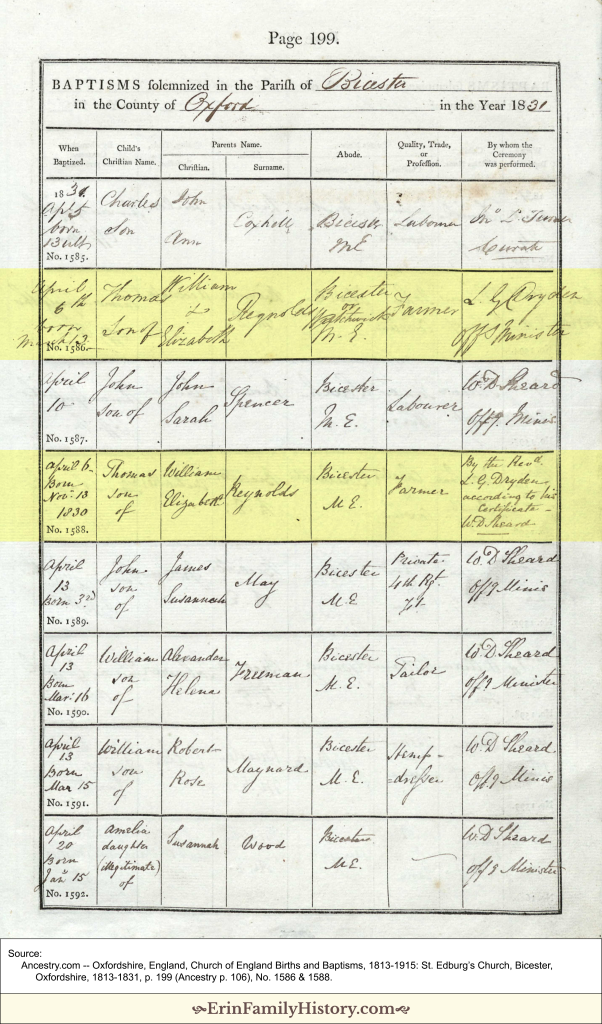
Thomas Reynolds was baptized at St. Edburg’s Church, Bicester (pronounced “BISSter”), Oxfordshire, England on 6 April 1831 by Rev. L. G. Dryden of the Church of England.
Double Entry
Thomas’ baptism was recorded twice on the same page, but in different hands.
The first entry lists Thomas’ birth date as 13 March (incorrect) and the residence of his parents as Bicester M. E. (Market End) or Wretchwick. This is presumed to be in Reverend L. G. Dryden’s hand. Wretchwick Hamlet was listed on a later census as the birthplace of Thomas’ father, William.
The second entry, two lines down from the first, lists Thomas’ birth date as 13 November (correct) and residence as Bicester Market End. This is presumed to be in Reverend W. D. Sheard’s hand. The handwriting in the book seems to be that of W. D. Sheard going forward. It is likely that Dryden was transferred and replaced by Sheard and the confusion caused by the change resulted in the double entry. Dryden was later the vicar of Ambrosden, a village not far from Merton and Bicester.
Transcription
Page 199. BAPTISMS solemnized in the Parish of Bicester in the County of Oxford in the Year 1831
When Baptized.
Child’s Christian Name.
Parents Name. Christian
Parents Name. Surname
Abode.
Quality, Trade, or Profession.
By whom the Ceremony was performed
April 6th born March 13 No. 1586
Thomas Son of
William & Elizabeth
Reynolds
Bicester or Wretchwick M. E.
Farmer
L. G. Dryden Offs Minister
April 6 born Nov. 13 1830 No. 1588
Thomas Son of
William Elizabeth
Reynolds
Bicester M. E.
Farmer
By the Revd L. G. Dryden according to his Certificate – W. D. Sheard
Source
Baptism record: Ancestry.com, Oxfordshire, England, Church of England Births and Baptisms, 1813-1915: St. Edburg’s Church, Bicester, Oxfordshire, 1813-1831, p. 199 Ancestry p. 106), No. 1586 & 1588.
From the Oxford Chronicle and Reading Gazette, 2 Jan 1847, page 3
Transcription
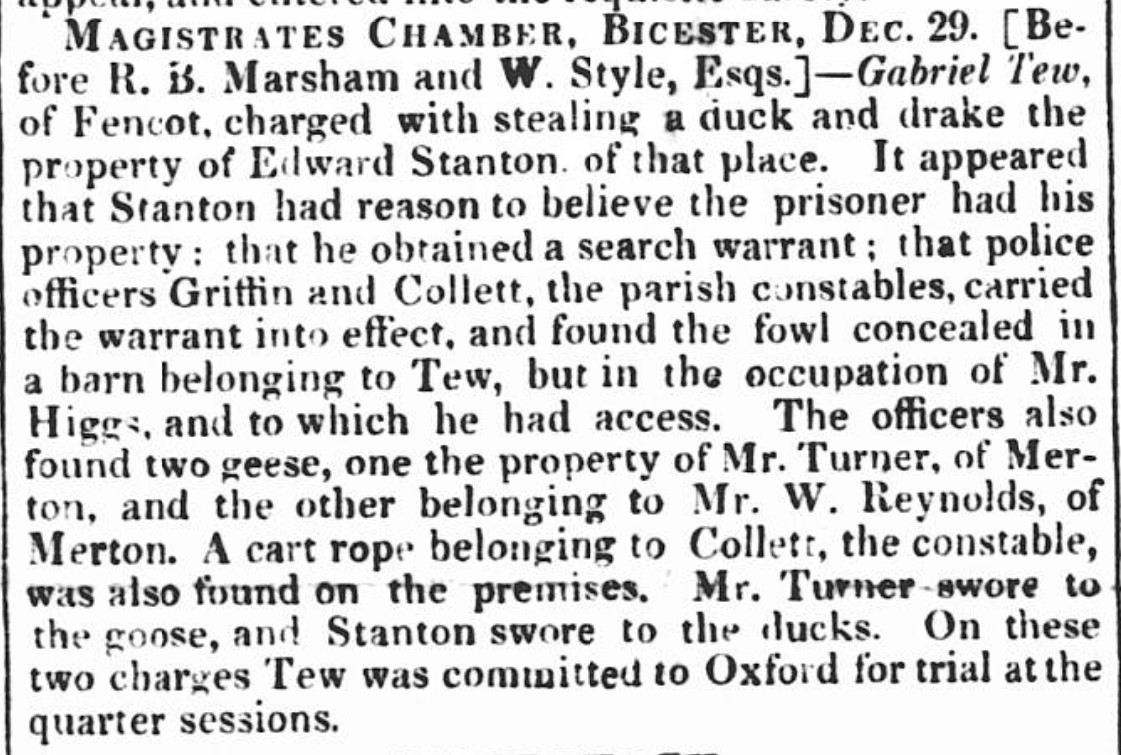
MAGISTRATES CHAMBER, BICESTER, DEC. 29 [1846]. [Before R. B. Marsham and W. Style, Esqs.] -- Gabriel Tew, of Fencot, charged with stealing a duck and drake the property of Edward Stanton of that place. It appeared that Stanton had reason to believe the prisoner had his property; that he obtained a search warrant; that police officers Griffin and Collett, the parish constables, carried the warrant into effect, and found the fowl concealed in a barn belonging to Tew, but in the occupation of Mr. Higgs, and to which he had access. The officers also found two geese, one the property of Mr. Turner, of Merton, and the other belonging to Mr. W. Reynolds, of Merton. A cart rope belonging to Collett, the constable, was also found on the premises. Mr. Turner swore to the goose, and Stanton swore to the ducks. On these two charges Tew was committed to Oxford for trial at the quarter sessions.
Notes
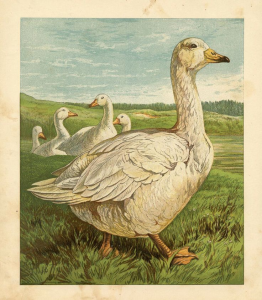
“The Goose” from Harrison Weir’s Pictures of Animals, 1877
A goose was worth between four and six shillings at the time of this occurrence. According to British National Archives, that would be £15-25 GBP in today’s money or $20-30 USD. That would be a day’s wages for a skilled tradesman.
William Reynolds, for whatever reason, did not press charges against Mr. Tew. When the trial came, Mr. Tew only charged in the theft of one goose, that owned by Mr. Tanner, and not in the theft of the ducks belonging to Mr. Stanton (see below, “The Trial,” for follow-up). A jury found him not guilty due to lack of evidence.
Mr. W. Reynolds of Merton was my 4th great-grandfather, William Reynolds (1790–1860). He was the tenant of Merton Grounds Farm near Merton, Oxfordshire, at the time of the theft of his goose. Merton Grounds was a dairy farm, but William seems to have had other livestock. He was a widower, having lost his wife Elizabeth a year before. Three of his children still lived with him at this time: Elizabeth, 21; Edward, 18; and my third great-grandfather, Thomas, 16.
The Trial
The following is a transcript of the court proceedings against Mr. Tew. This appeared in the Oxford Chronicle on 9 Jan 1847:
County Epiphany Sessions.

These sessions commenced on Monday, before J. W. Henley, Esq. and a bench of magistrates, when the county business was transacted...

On Tuesday the trial of prisoners commenced.  The grand jury having been sworn, and the royal proclamation against vice and immorality having been read, the chairman, in a few words, addressed the grand jury, by saying that he was sorry that he could not congratulate them (as at the last sessions) on the state of the calendar.  The number of prisoners was unusually large.  This might probably arise in some measure from the late severity of the weather, which might have led to the commission of smaller offences... There were 40 prisoners in the calendar...

Gabriel Tew, 47, was charged with stealing one goose, the property of Wm. Tanner, of the parish of Merton.

Mr. Pigott defended the prisoner.

The first witness was William Tanner, who deposed that he lived at Merton, in this county.  Last December had twelve geese; saw them on Friday, Dec. 18; missed two on the Saturday.  They were old ones; worth 5s. or 6s. each.  Saw one about a fortnight after in the possession of Griffin, the policeman.  It was dead; that was the brown one.  Saw the white one in possession of Jackson; it was picked.

In reply to Mr. Piggot. -- Both were picked except the head and wings.  Knew it by the white feathers and brown feathers round the head.  Could not swear to the white one.

Anne Edwards, servant to William Tanner. -- Had the care of his poultry.  He had twelve geese on the 18th of December.  She put them into the house without locking them up.  Next morning missed two.  Saw a brown goose at Mr. Griffin's on the 28th of Dec.  She knew it by its head.  Had looked after them two years.

In reply to Mr. Pigott. -- She did not miss them till told they were gone.  The one she saw on the 28th was picked; it had a brown and white head.  Other people in the parish kept geese.

Fracis Griffin, policeman, Bicester. -- He produced the head and wings of a goose.  He found the goose belonging to them in a barn of Mr. Higgs, of Fencott, in a bag.  It is the prisoner's barn, and Mr. Higgs rents it.  Prisoner lives in a house near the barn.  Searched the prisoner's house first; found nothing.  Then, by leave of Mr. Higg's daughter, searched the barn.  It was unlocked; no one was at work in it.  There was some wheat straw in the barn.  There were two doors to the barn, neither of which open into the street.  Prisoner was present when he searched, and in turning out the goose, witness said, this must be Mr. Tanner's goose, and prisoner said, yes.  Had told prisoner what he came to search his house for.  Shewed the goose to Mr. Tanner the same day, the 28th of December.

Mr. Tanner swore to the head.

In reply to Mr. Pigott. -- Did not know that geese were often brown.  Ganders were generally white.  Did not often feed the poultry.  Mr. Reynolds lived at Merton grounds.  He had lost a white goose, and he swore the white one was his.  Witness was sure it was his.

Francis Griffin, in reply to Mr. Pigott, said, Higgs rented his barn and house of prisoner; it was his own property.  He allowed him to search his house; he said, "search and welcome."  When the goose was found he (witness) said, this is Tanner's goose; prisoner said, yes.  He (witness) had not stolen the goose (laughter).

Anne Edwards said, the goose's head was her master's.

Richard Collett, constable of Fencott, was with Griffin, when two geese were found in a bag, in Mr. Higg's barn.

John Higgs. -- Lives at Fencott; rented a barn there of Tew, and occupied it.  The prisoner had the privilege to go in the barn at any time.  If he chose to lock him out he could.  Made no bargain that he should have a right to go into it, when he let it to witness.  He could go into it when unlocked, the same as anybody else might.  Sometimes put corn into the barn, then locked it by night only.  He had some wood in the barn.

In reply to Mr. Pigott: -- Had a son and daughter grown up.  Went through a stable into the barn.

Mr. Pigott submitted there was no evidence.

The Chairman said he thought it very slight.

Mr. Pigott then said he was willing the case should [go to?] the jury as it was.

The Chairman, then said, the evidence was indeed slight, and the jury immediately returned a verdict of not guilty.
From The Bicester Herald, Bicester, Oxfordshire, England, 17 Jan 1857, page 8
Transcription
THE ANNUAL BALL AT THE ASSEMBLY ROOMS, AT THE BLACK BOY INN, BICESTER took place on the evening of Tuesday last [13 Jan 1857], when between 60 and 70 ladies and gentlemen of the town and neighbourhood, enjoyed the festive dance. The arrangments, and the superior way in which they were carried out, gave general satisfaction. The room was decorated with taste, and had a pleasing effect. Bell's Leamington Quadrille Band acquitted itself to the full satisfaction of the company. The refreshments, supplied by Mr. and Mrs. Reynolds, were all that could be desired, and displayed their ability as purveyors. Dancing commenced at nine, and was kept up with spirit for some hours. The meeting was of the most agreeable character, and hopes were expressed that the anticipated one for 1858 might be no less so.
Notes
The ball occurred in the second-floor assembly rooms of the Black Boy Inn. The Black Boy seems to have been a popular venue for meetings, dinners, and other gatherings in Bicester. My 3rd great-uncle, John Reynolds (1823–1878), and wife, Sarah Claridge Reynolds (1798–1873), hosted these events and ran their pub and butcher shop downstairs.
My ancestor, Thomas Reynolds (1830–1894), was John’s younger brother. I have no doubt that Thomas, who was then twenty-seven years old and unmarried, attended this ball. The following June, he boarded a ship for America.
Ball gowns from Peterson’s Magazine, Les Modes Parisiennes, January 1857 (the same month as the ball) From LAPL, found on Pinterest
The word “ball” conjures visions of exquisite gowns, tuxedos, and waltzing in a grand ballroom. But this would have been an event for the commoners of Bicester—what we might call a “dance.”
"All ... social classes tended to refer to the dances they held as balls. By the mid-[19th] century, the majority of the dances performed in a typical ball were waltzes, quadrilles, polkas, galops, and schottisches with a few country dances and other older dances included."