Thomas Reynolds is Baptised

Thomas Reynolds was baptized at St. Edburg’s Church, Bicester (pronounced “BISSter”), Oxfordshire, England on 6 April 1831 by Rev. L. G. Dryden of the Church of England.

Double Entry

Thomas’ baptism was recorded twice on the same page, but in different hands.

The first entry lists Thomas’ birth date as 13 March (incorrect) and the residence of his parents as Bicester M. E. (Market End) or Wretchwick. This is presumed to be in Reverend L. G. Dryden’s hand. Wretchwick Hamlet was listed on a later census as the birthplace of Thomas’ father, William.

The second entry, two lines down from the first, lists Thomas’ birth date as 13 November (correct) and residence as Bicester Market End. This is presumed to be in Reverend W. D. Sheard’s hand. The handwriting in the book seems to be that of W. D. Sheard going forward. It is likely that Dryden was transferred and replaced by Sheard and the confusion caused by the change resulted in the double entry. Dryden was later the vicar of Ambrosden, a village not far from Merton and Bicester.
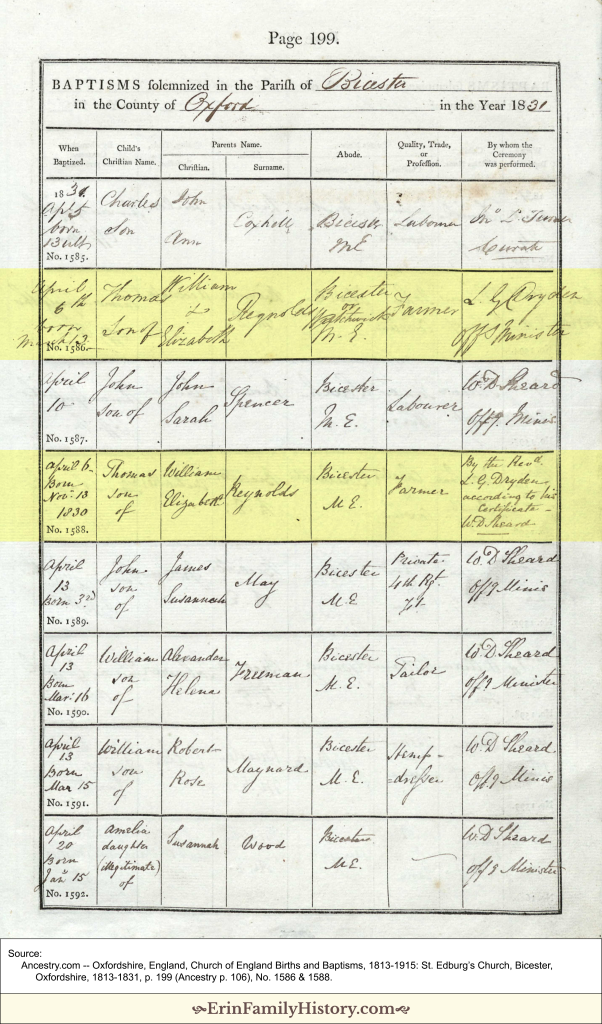
Transcription

Page 199.
BAPTISMS solemnized in the Parish of Bicester
in the County of Oxford in the Year 1831

When
Baptized.
Child’s
Christian
Name.
Parents Name.
Christian
Parents Name.
Surname
Abode.Quality,
Trade,
or
Profession.
By whom the
Ceremony
was performed
April
6th
born
March 13

No. 1586
Thomas
Son of
William
&
Elizabeth
ReynoldsBicester
or Wretchwick
M. E.
FarmerL. G. Dryden Offs
Minister
April 6
born
Nov. 13
1830

No. 1588
Thomas
Son of
William
Elizabeth
ReynoldsBicester
M. E.
FarmerBy the Revd
L. G. Dryden
according to his

Certificate –
W. D. Sheard

Source

Baptism record: Ancestry.com, Oxfordshire, England, Church of England Births and Baptisms, 1813-1915: St. Edburg’s Church, Bicester, Oxfordshire, 1813-1831, p. 199 Ancestry p. 106), No. 1586 & 1588.

13 January 1857 – Annual Ball at the Black Boy

From The Bicester Herald, Bicester, Oxfordshire, England, 17 Jan 1857, page 8

Transcription

THE ANNUAL BALL AT THE ASSEMBLY ROOMS, AT THE BLACK BOY INN, BICESTER took place on the evening of Tuesday last [13 Jan 1857], when between 60 and 70 ladies and gentlemen of the town and neighbourhood, enjoyed the festive dance.  The arrangments, and the superior way in which they were carried out, gave general satisfaction.  The room was decorated with taste, and had a pleasing effect.  Bell's Leamington Quadrille Band acquitted itself to the full satisfaction of the company.  The refreshments, supplied by Mr. and Mrs. Reynolds, were all that could be desired, and displayed their ability as purveyors.  Dancing commenced at nine, and was kept up with spirit for some hours.  The meeting was of the most agreeable character, and hopes were expressed that the anticipated one for 1858 might be no less so.

Notes

The ball occurred in the second-floor assembly rooms of the Black Boy Inn. The Black Boy seems to have been a popular venue for meetings, dinners, and other gatherings in Bicester. My 3rd great-uncle, John Reynolds (1823–1878), and wife, Sarah Claridge Reynolds (1798–1873), hosted these events and ran their pub and butcher shop downstairs.

My ancestor, Thomas Reynolds (1830–1894), was John’s younger brother. I have no doubt that Thomas, who was then twenty-seven years old and unmarried, attended this ball. The following June, he boarded a ship for America.

Ball gowns from Peterson’s Magazine, Les Modes Parisiennes, January 1857 (the same month as the ball) From LAPL, found on Pinterest

The word “ball” conjures visions of exquisite gowns, tuxedos, and waltzing in a grand ballroom. But this would have been an event for the commoners of Bicester—what we might call a “dance.”

"All ... social classes tended to refer to the dances they held as balls. By the mid-[19th] century, the majority of the dances performed in a typical ball were waltzes, quadrilles, polkas, galops, and schottisches with a few country dances and other older dances included."

https://dalestunes.org.uk/quadrille-bands-and-string-bands/

The Leamington Quadrille Band, a popular traveling band mentioned in newspapers from the mid-1820s to the late-1850s, provided the music.

“The size and composition of quadrille bands varied … tended to have three or four members and to be led by a fiddle player.”

https://dalestunes.org.uk/quadrille-bands-and-string-bands/

Sources